What Are AI Agents? A Guide for Businesses
Contents
AI agents are artificial intelligence systems that make decisions on their own to reach a goal, plan and execute multi-step tasks, and autonomously use tools (software, databases, APIs) along the way. While a classic chatbot only responds to the question you ask, an AI agent takes on an entire task end to end, such as “approve this invoice, update the stock record, and notify the customer.” Just how pivotal this shift is becomes clear in the numbers: according to Gartner, at least 15% of day-to-day work decisions will be made autonomously through agentic AI by 2028, up from 0% in 2024.
In this guide, you will learn step by step what AI agents are, how they differ from classic automation and chatbots, how they work, their enterprise use cases, their concrete benefits, the risks to watch for, and how to get started in your own business.
What Is an AI Agent? How It Differs from a Chatbot
AI agents use a language model (LLM) as their “brain” but go far beyond it. An agent perceives its environment, plans toward a goal, breaks that plan into steps, calls the necessary tools, and corrects course by evaluating the results. Four core traits set AI agents apart from classic systems:
- Autonomy: The agent continues the task without a human instructing every step.
- Goal orientation: It works by “produce this outcome,” not “say this.”
- Tool use: It sends emails, queries databases, calls APIs, and prepares reports.
- Multi-step reasoning: It splits a task into logical sub-steps and executes them in order.
In short, a chatbot knows “what to say,” while AI agents know “what to do.” A rule-based automation (RPA) merely repeats a pre-written script, whereas an agent adapts to unexpected situations and generates decisions. Getting this distinction right requires a solid AI solutions foundation.
How Do AI Agents Work?
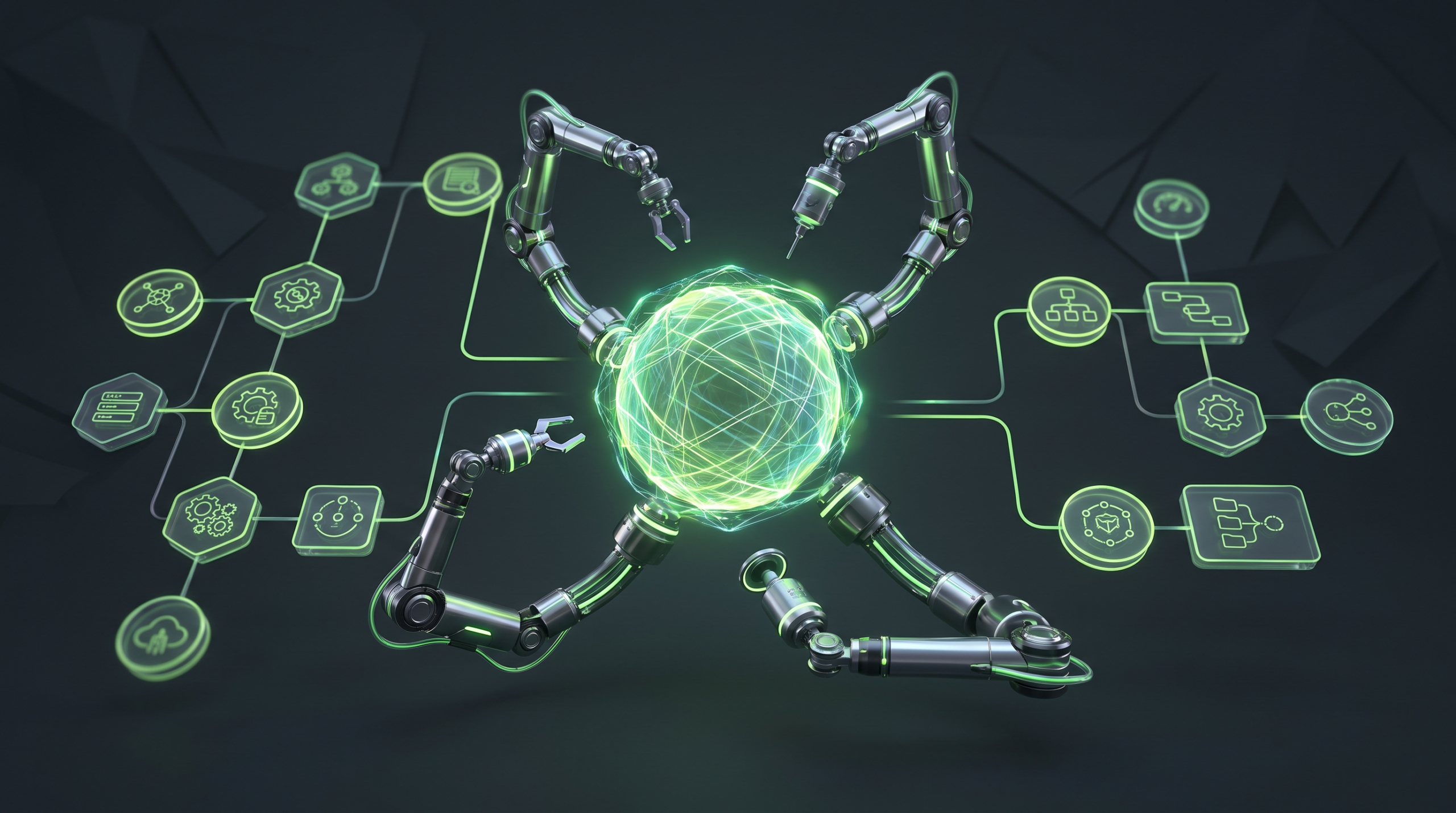
An agent’s operating loop usually has four stages: perceive, plan, act, learn. First it perceives the user’s request and available data. Then it derives a plan to reach the goal and breaks it into concrete steps. At each step it runs the appropriate tool (for example, updating a CRM record or checking stock). Finally it evaluates the result and revises its plan if something went wrong. This loop lets the agent manage a continuous workflow rather than a one-off answer. The market is investing rapidly in this capability: Gartner predicts that 40% of enterprise applications will feature task-specific AI agents by the end of 2026, up from less than 5% in 2025.
Enterprise Use Cases and Benefits
For businesses, AI agents are not an abstract concept but measurable efficiency. Leading enterprise scenarios include:
- Customer service: Agents that understand a request, initiate returns, track shipments, and escalate to a human when needed.
- Sales and marketing: Agents that qualify leads, prepare quotes, and autonomously run follow-up emails.
- Operations and logistics: Agents that monitor and manage orders, inventory, and shipments end to end.
- Data analysis: Agents that scan raw data and turn it into meaningful insights and reports.
The pace of adoption confirms this potential. According to Deloitte research, 25% of generative AI users are launching agentic pilots in 2025, and that figure is expected to reach 50% by 2027. Most of these scenarios deliver the highest value through a custom software development approach integrated with your existing systems.
How to Get Started: Risks and Human Oversight
AI agents are as powerful as they are demanding to design carefully. For a successful start, first choose a high-volume, repetitive process with clear rules; keep the scope narrow and move forward with a pilot. But do not ignore these risks:
- Human oversight: Keep a “human approval” step for critical decisions; move to full autonomy gradually.
- Data security and privacy: Monitor what data the agent accesses and what it does, and limit its permissions.
- Auditability: Log every step so the reasoning behind each decision remains traceable.
Gartner’s warning underscores how serious these risks are: due to insufficient risk controls and unclear business value, more than 40% of agentic AI projects are expected to be canceled by the end of 2027. Getting it right means centering the business problem, not the technology. Futurecode’s enterprise software services make this transition safe and measurable.
Frequently Asked Questions
What is the key difference between an AI agent and a chatbot?
A chatbot only generates responses; AI agents plan multi-step tasks to reach a goal, use tools, and make decisions to run the work from start to finish.
Which industries use AI agents?
They are widely used across logistics, e-commerce, finance, manufacturing, healthcare, and services, in customer service, sales, operations, and data analysis processes.
How do I start an AI agent project?
Launch a pilot with a narrow, repetitive, and measurable process. Design human oversight and security controls from the outset and proceed with an experienced software partner.
Will AI agents replace human employees?
In most scenarios, agents take over repetitive work and free employees for higher-value tasks; human oversight remains the standard for critical decisions.
Start Your AI Journey with Futurecode
AI agents sit at the center of a transformation that will redefine your organization’s efficiency. Based in Ankara, Futurecode brings together custom software, AI solutions, and enterprise consulting, drawing on experience with more than 126 clients to design this transition around your business problems. To build a secure, scalable agent architecture that works with your own data, get in touch with us. For a deeper look at the topic, explore Gartner’s agentic AI predictions.